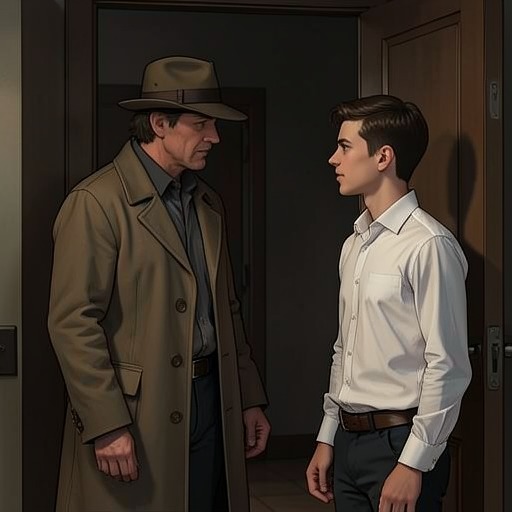
William Henry Devereaux Jr. and His Estranged Father, William Henry Devereaux Sr.
Straight ManWilliam Henry Devereaux, Jr., and his father, William Henry Devereaux, Sr., are bound by admiration, distance, and an abandonment the son cannot simply outgrow. The father’s public reputation as a major literary scholar contrasts with the son’s most intimate memory of him: a man standing beside a freshly dug grave for the family dog, uncertain how to respond to his child. Across the relationship, the son keeps trying to understand a father who seemed to need no one, while recognizing how that appearance shaped the family long after the father left.
Identity and Background
William Henry Devereaux, Sr. is an ambitious academic whose career thrives on intellectual fashion. By the time his son is nine, he has published several books, become a full professor, and held visiting appointments that give him light teaching duties and time to write. His wife, also an English professor, is hired as part of the arrangement and carries a full teaching load. The family moves repeatedly between university homes; the one they occupy when the boy is nine is already their fourth. The father’s professional mobility and confidence belong to a life organized around institutions, books, and reputation, while the child experiences the instability more directly.
The parents later divorce, when their son is in junior high school. They agree on little, but both describe him as an exasperating child. Their shared account of his first dog is one of the few family stories they tell in strikingly similar ways. That convergence matters: the story becomes a point at which the parents’ separate versions of family life overlap, and the son’s recollection of his father is inseparable from the loss that gives the anecdote its shape.
The Dog and the Father’s Departure
The son’s most concrete early image of his father comes not from the scholar’s books or public reputation but from the burial of the family’s dead Irish setter. The father has borrowed a shovel and dug the grave. His cordovan loafers are ruined, and his hands are dirty and blistered. When the boy suggests naming the dog Red, the father lets the shovel go, its handle striking the ground near the child’s feet, and asks what he means. The moment registers as an encounter between a father who is accustomed to the printed page and a son whose grief cannot be made to fit neatly into it.
Years later, the son suspects that burying Red was among the few experiences in his father’s life that had not begun on a page. The image stands in deliberate contrast to the celebrated scholar: the father is briefly present in practical work, yet even here the child senses that he cannot make himself understood. When the father leaves the family, the loss is not confined to a marriage ending. The son’s later reflection connects the mother’s pain at his abandonment to the childhood anguish shared between mother and son, suggesting that the father’s absence continues to organize bonds within the family.
The father becomes more famous after leaving. He is credited with helping found American literary theory, publishes scholarship, and writes a literary memoir about prominent twentieth-century literary figures. His photograph appears in literary reviews, first in a period associated with tweed, crewneck sweaters, and gold chains, and later in a button-down shirt and tie among the books in his office. For his son, however, these images do not replace the scene with the shovel. Public recognition enlarges the distance between the celebrated father and the private figure the son remembers.
Pursuit and Emotional Distance
As a boy, the son seeks his father’s company. On weekend mornings he lies on the floor near his father’s reading chair, studying an encyclopedia while the older man reads. He knows not to interrupt for fear of one of his father’s scowls, and, after spending hours quietly beside him, asks his mother about breakfast when she comes downstairs. The boy’s proximity to his father is real, but the intimacy remains limited: he can share a room and a routine without being invited into an emotionally reciprocal relationship.
The father’s apparent self-sufficiency intensifies the attraction. When he goes somewhere, he leaves his son free to come along or stay behind; the boy repeatedly chooses to follow. He prefers his mother’s company in one respect, because she pays attention to him and seems glad to have him there, yet that very welcome makes her less compelling when his father is available. Only later does he understand that his efforts to get close to his father were largely futile. The father’s manner suggests that he needs nothing from others, a quality that the son recognizes as both powerful and painful.
The son interprets that self-possession in relation to the father’s success with young women in graduate programs. He imagines that the father conveyed indifference so persuasively that others felt more invested in winning his attention than he was in receiving theirs. The son’s claim that he had courted his father too makes the emotional pattern explicit: the child is not merely following a parent but pursuing the approval of someone whose distance appears to enhance his authority.
Memory, Money, and Competing Accounts
The relationship reappears in adult conversation through practical obligations and disputed memories. When William Henry Devereaux, Jr. and his wife moved to Railton, delayed publication money for Off the Road left them worried that they could not pay the movers. His father wired them fifteen hundred dollars. The son’s wife recalls that he returned the check by express mail almost immediately, as if he could undo the fact of having needed help. The son does not remember the circumstances clearly and doubts that his father took offense. The episode nevertheless reveals how assistance could become entangled with pride and the son’s wish to avoid dependence on the man who had already left.
The son and his wife differ over their respective fathers: he persists in liking hers, while she continues to like his. His mother, meanwhile, keeps the name Mrs. William Henry Devereaux in her newspaper byline, despite the divorce. She presents her continued use of it as a matter of intellectual independence, but her son understands it as an enduring identification with the husband who abandoned her. The byline creates a public confusion between mother and son’s wife and obliges both the son and Lily to answer for opinions they do not hold. Thus the father’s absence remains active in the family’s social identity, not merely a private memory.
The son also writes an autobiographical column about acquiring, naming, and burying Red after learning that his father will return to the family. His mother objects to his use of humor and challenges the essay’s accuracy and truthfulness. Her response exposes another division in how the father is remembered: what the son treats as a story about the dog and a formative childhood moment, she evaluates against her own long expectation that her husband would come back. Before that return, she warns her son that he is unprepared. He replies that the departure, not the return, was what he had not been prepared for. The distinction gives the relationship its adult terms: a father may reappear, but that does not erase the earlier rupture.
Inherited Distance and Narrative Significance
The son contrasts his father’s disciplined mornings with his own troubled nights. As a boy, he imagined adulthood as freedom from doubt; his father, clean-shaven and reading in his study before dawn, seemed to embody that freedom. Only later does the son consider what the child could not know: his father may have spent the night in illicit relationships and relied on morning routine and literary criticism to put guilt aside. The adult narrator recognizes that an appearance of composure does not prove an absence of fear or remorse. He also insists that he is not his father’s son in temperament, yet his reflections repeatedly show how deeply he has been shaped by the comparison.
A childhood episode in the cellar further reveals how abandonment reverberates through the next closest bond. His mother finds him testing a rope tied to a pipe, and he turns to her in grief he had not known how to express. He later explains that he did not want his life to end; he wanted to know whether the pipe would hold if circumstances became unbearable. His mother embraces him and promises that they will forget the moment. As an adult, he wonders whether their shared effort to forget his father’s abandonment also required them to distance themselves from one another. The memory therefore makes the father-son rupture visible through its effects on the mother and child who remain.
The son’s mature reflections resist treating anyone as fully knowable, including oneself. He sees family, friends, and colleagues as necessary witnesses who may understand a person’s likely actions better than that person does. His father’s apparent independence, the boy’s pursuit of him, and the lasting consequences of his departure all complicate any simple account of who either man is. The relationship is significant not because the father’s return resolves it, but because the son’s narration keeps revisiting the gap between what a person appears to be, what others need from him, and what only becomes legible after a choice has already altered a family.